
Taking Life in Stride: How a Penn State alumna forged her own path


Life after college looks different for every graduate that walks across the stage during commencement. Some go to medical school, some go to graduate school, and others go right to industry. One Eberly College of Science alumna, Kristina Kaldon, forged her own path after she graduated in 2015 with two degrees—a bachelor’s in astronomy and astrophysics and in physics.
“Real life is like scientific research; there isn’t always a straightforward approach or answer,” she said.
As a student, Kaldon was heavily involved: She hosted 3D Mars Rover shows next to the planetarium on campus, participated in undergraduate research, and was a member of clubs including the Society of Physics Students, Astronomy Club, and Science LionPride. Through these clubs, she was able to learn from invited professionals about the different career path options that were available to her after graduation. Although Kaldon’s original goal was to attend graduate school and earn a doctoral degree, she learned that there were many options for someone with a science degree beyond pursuing graduate school.
“It was fantastic to see the different career tracks people can take and learn how to pitch your skills,” Kaldon said. “Resources at Penn State like career services were beneficial to me as a student. I didn’t realize it at the time, but they were helping build the skills that would create my view of how to approach the job market.”
Kaldon also participated in undergraduate research, which she found deeply insightful and taught her problem solving, critical thinking, and deep research methods. These skills, she said, helped her throughout her daily life and career.
Kaldon’s research also opened the door to a position as an assistant systems engineer developing space systems software at the Massachusetts Institute of Technology, where she was recruited as a student at the Penn State career fair.
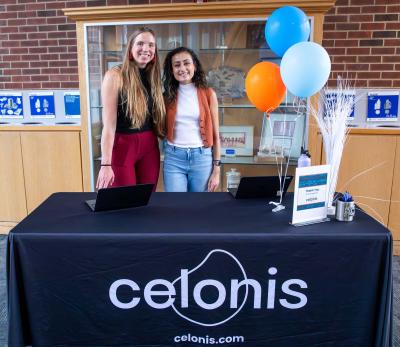
But when new opportunities presented themselves, she left MIT for a healthcare startup in Puerto Rico, then pivoted to another startup based in Washington, DC that focused on robotic process automation. Kaldon built and led an academic partnerships team throughout the company’s stock market debut, successfully growing the program to support more than 300 university partnerships. From this, she transitioned to her current role as the lead academic partner manager at Celonis—a leader in AI and data process mining software used to improve business processes.
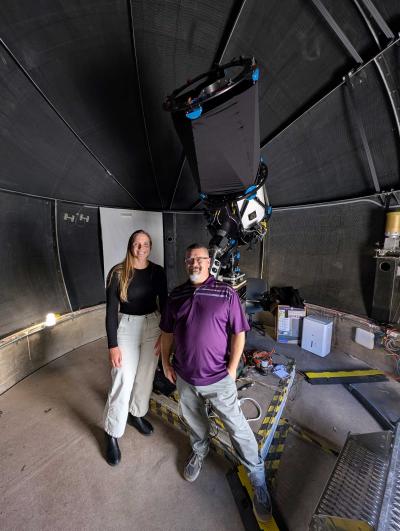
To keep her connection with astronomy and foster her love of teaching, Kaldon works part-time as a museum guide at the Griffith Observatory and as a telescope demonstrator at Mount Wilson Observatory in Los Angeles. She is also an active volunteer with the Griffith Observatory Foundation, Los Angeles Astronomical Society, and CoachArt. It was her student experience volunteering for astronomy outreach, such as for the Mars Rover shows, that originally inspired her and gave her the confidence to never stop sharing her love of the cosmos.
“It instilled a love of teaching, a love of research, and working with students and volunteering,” said Kaldon. “At Penn State, I was doing outreach with my advisor, Chris Palma. He’s a huge champion of giving back and sharing your time, and I think that honestly inspired me to do what I do in my career. It’s important to remember that learning is fun!”
This year, Kaldon returned to Penn State for DataFest, a weekend-long data analysis competition sponsored by the American Statistical Association. As an additional sponsor of DataFest, Celonis gave participating students the opportunity to work with their technology to analyze data and build out data visualization solutions for their presentations.
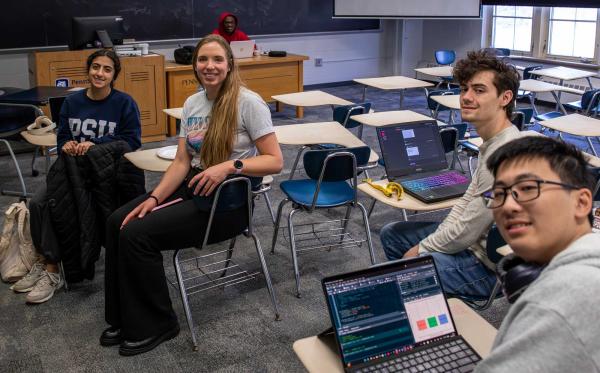
“My colleagues and I were working with the students, and I showed them how I would have approached the same data sets they were working with,” said Kaldon. “There was also a prize for the Best Use of the Celonis Platform for the group who used the technology to identify and visualize the most unique insights within the data sets.”
It was through DataFest that Kaldon felt she was able to give back to her alma mater, which shaped her as a young adult through its opportunities for learning, volunteering, and growing professionally.
“There are so many alumni who want to give back, but they don’t know how,” said Kaldon. “One way is through sharing your time, and DataFest allowed me to bring in my employer’s resources to help mentor students and give back that way.”