
Summer School for Early Career Astrophysicists


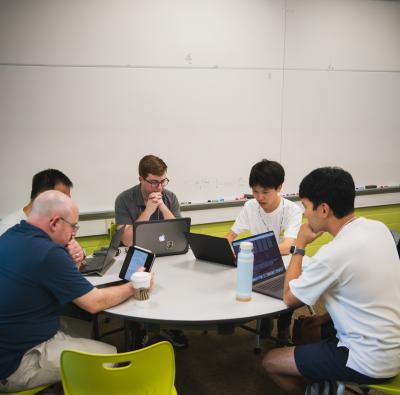
This summer, 53 graduate students and postdoctoral researchers and 18 instructors representing 38 universities and institutions across 3 continents attended an intensive 2-week program on Penn State’s University Park campus. During the program, participants attended lectures and learned how to apply an open-source code called AthenaK for their own research in computational astrophysics.
AthenaK is a freely accessible code that provides an infrastructure for astrophysical simulations, used, for example, to model the distribution of dark matter or what happens when cosmic objects collide. The code operates under a variety of modern computing technologies.
The summer workshop was funded in part by a Sustainment Award from NASA to workshop organizer David Radice, associate professor of physics and of astronomy and astrophysics, and his colleagues to advance AthenaK for computational astrophysicists.